The Legend And History Of The Huacachina Oasis
A mermaid, a shattered mirror, and dunes said to be her cloak. That is the story locals tell about how Huacachina's lagoon came to be. The real history is stranger in its own way: a genuine natural oasis whose water has needed to be artificially pumped in since 2015 to keep it from disappearing.
Most visitors to Huacachina know the oasis for one thing: the photo, a small green lagoon ringed by palm trees, boxed in by towering golden dunes, best seen at sunset. Fewer know that the same lagoon carries a local legend explaining its origin, or that its water level has been the subject of genuine environmental concern for decades. Both the legend and the real history are worth knowing before you go, since they explain why the oasis looks the way it does today and why locals treat it as something worth protecting, not just photographing.
If you have already decided the visit is worth your time, our guide on whether Huacachina is worth visiting covers what the destination delivers today. This guide covers where it came from.
The Legend Of Huacachina
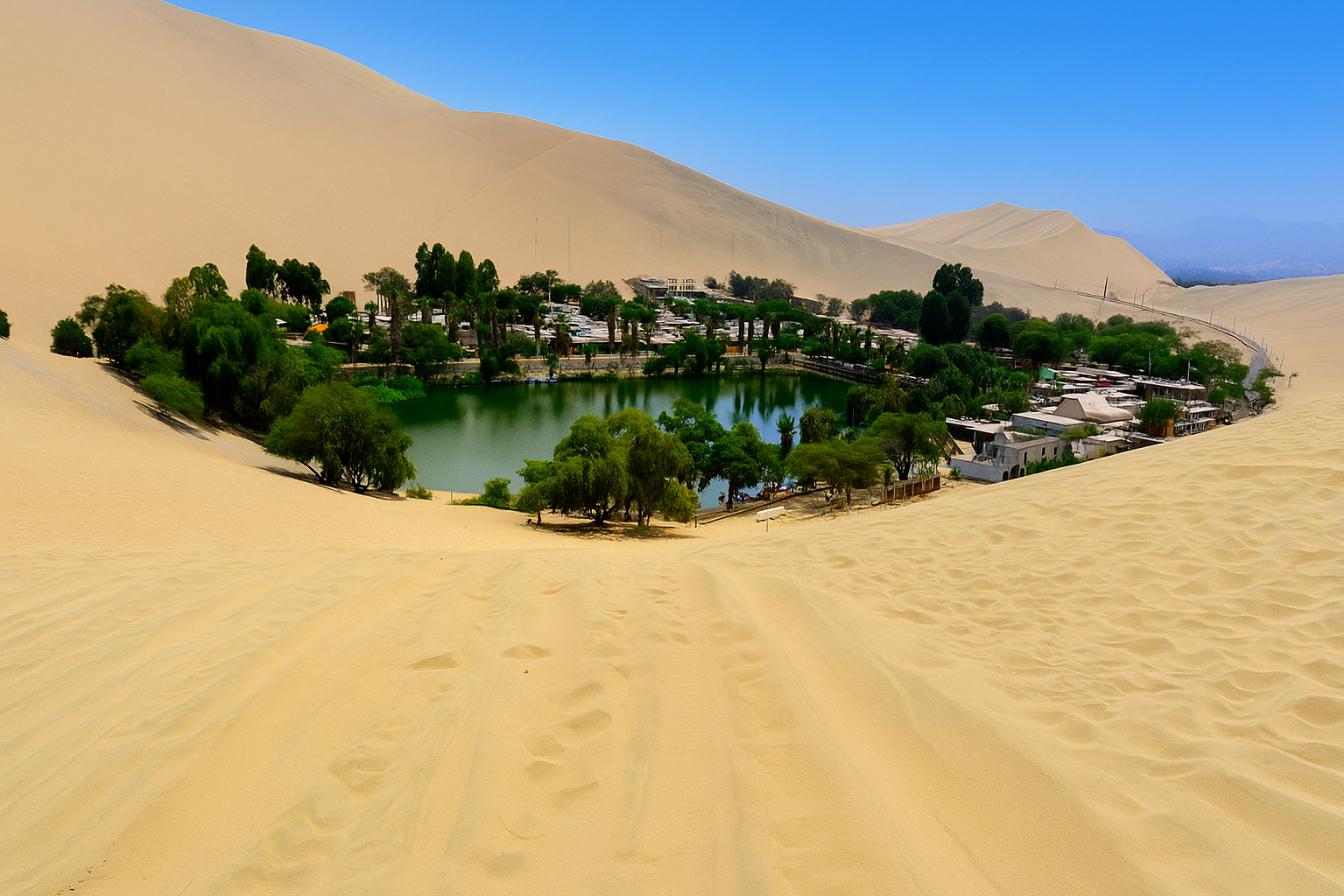
The most commonly told version: a beautiful native princess was bathing in a pool of water in the desert when a hunter approached and startled her. In her alarm, she fled, and behind her the water she had been bathing in, or in some versions her mirror, transformed into the lagoon that exists today. Her flowing mantle, left behind as she fled, is said to have become the sand dunes that now ring the oasis on every side.
The mermaid element: local legend holds that the princess did not simply vanish, she remained in the oasis and became a mermaid living in the lagoon itself. As the story is told locally, she still appears under the full moon, visible from the water's surface, and the legend is part of why the lagoon has held a kind of protected, almost sacred status among locals independent of its tourist appeal.
Why the story persists: a natural body of water appearing in the middle of one of the driest deserts on earth genuinely does look inexplicable without an explanation, and a legend involving transformation and disappearance fits the visual strangeness of the place better than a dry geological description would. It is worth treating the story as exactly that, a legend, rather than literal history, but it remains a real and often-repeated part of how Huacachina understands its own origin, and asking a local guide about it during a visit typically gets you their own version of the tale.
Versions vary, and that is normal for oral legend: some tellings name the man who startled her a hunter, others a suitor she was actively fleeing from rather than a stranger who simply appeared. Some versions describe her mirror shattering into the lagoon, others describe the pool she was already bathing in transforming beneath her. This kind of variation is typical of a story passed down locally rather than recorded in a single authoritative text, and it is part of why asking two different guides in Huacachina can genuinely get you two slightly different versions of the same core tale.
The name itself: the oasis and the town share the name Huacachina, and the legend's central figure is sometimes given a name close to this in local tellings, which is part of why the legend and the place feel so directly connected rather than existing as two separate stories that happen to share a setting. Whether the name gave rise to the legend or the legend gave the place its name is, appropriately, itself a matter of local storytelling rather than settled record.
| Legend Element | What It Explains |
|---|---|
| The fleeing princess | Why the oasis has a human, not purely natural, origin story |
| The shattered mirror or pool | The origin of the lagoon itself |
| Her flowing mantle | The origin of the surrounding dunes |
| The mermaid who remains | Why locals treat the lagoon as more than just scenery |
How The Oasis Actually Formed
The real explanation is geological, not mythical: Huacachina's lagoon formed through natural seepage from underground aquifers reaching the surface at a low point in the desert, creating a pool of water that, over time, supported the palm trees and vegetation that now ring it. The surrounding sand dunes are a separate, ongoing process, desert sand shaped and piled by wind patterns specific to this stretch of Peru's coastal desert, rather than connected to the lagoon's formation directly.
Why this specific spot and not elsewhere nearby: the Ica region sits within one of the driest deserts in the world, and a natural oasis forming here depends on a specific combination of underground water reaching a low point in the landscape where it can pool at the surface rather than staying buried. That combination is genuinely rare, which is part of why Huacachina remains one of the only true desert oases of its kind that is this easily accessible to visitors in South America.
A natural phenomenon, tourist-shaped over time: the oasis itself predates its tourism industry by a considerable margin, and the palm trees, walking paths and buildings now surrounding the lagoon were added over decades on top of a genuinely natural water feature, not built around an artificial one from the start. That distinction matters for the next section, since what has changed in recent decades is not the oasis's origin but its water supply.
Is Huacachina Natural Or Man-Made Today?
Both, and the honest answer requires explaining why: the lagoon began as a genuinely natural feature, sustained by underground aquifer seepage. That natural supply came under real pressure starting in the early 2000s, as increased well-drilling in the surrounding agricultural region drew down the same groundwater the oasis depended on. To prevent the lagoon from shrinking or disappearing entirely, local business groups began artificially pumping water into the lake starting in 2015, a practice that continues today to maintain the water level visitors see.
What this means for a visitor today: the lagoon you see on a Huacachina visit is real water in a real natural depression, not a swimming pool built to look like an oasis. But its current water level is actively maintained rather than purely self-sustaining the way it may have been decades ago, a genuine environmental story rather than a minor technicality, and one that reflects a broader pattern of groundwater pressure affecting desert communities across the region, not something unique to Huacachina alone.
Why this is worth knowing rather than skipping over: a travel guide has an obvious incentive to present a destination as effortlessly, purely natural, since that framing sells better than a more complicated environmental reality. The honest version is more interesting anyway: a centuries-old natural oasis that a community has chosen to actively preserve rather than let disappear, which says something real about how much the lagoon means locally, well beyond its value as a tourist backdrop.
| Period | What Was Happening |
|---|---|
| Original formation | Natural aquifer seepage creates the lagoon |
| Early 2000s | Increased regional well-drilling begins threatening the natural water supply |
| 2015 | Local business groups begin artificially pumping water into the lagoon |
| Today | Water level actively maintained through continued pumping |
Source: Huacachina, Wikipedia.
From Summer Resort To Backpacker Hub
A destination for decades, not a recent discovery: Huacachina has drawn visitors for a very long time by Peru tourism standards, and by the 1960s it had already become a genuinely popular summer resort, drawing tourists from beyond Peru to the lagoon and the surrounding desert scenery well before the current wave of backpacker travel discovered it.
The shift to today's backpacker-focused town: the more recent identity Huacachina holds, as a stop on the standard Peru backpacker route between Lima and Cusco or Arequipa, built around dune buggy tours, sandboarding and a small cluster of party hostels, represents a newer layer on top of that older resort history rather than a replacement of it. The lagoon-front hotels that still operate today, some of the same properties covered in our guide to where to stay in Huacachina, are part of that continuity.
What stayed constant: across both eras, the summer-resort decades and the current backpacker period, the core appeal has stayed the same, an unusual desert landscape and a body of water where none should exist, reachable within a reasonable distance of Lima. What changed is who travels there and what they do once they arrive, from lagoon-side relaxation to buggy-and-sandboard adrenaline tourism.
From leisure destination to activity destination: the 1960s version of Huacachina tourism centered on the lagoon itself, swimming, relaxing lagoon-front, and enjoying the novelty of a desert resort. The dune buggy and sandboarding activities that now define most visits are a considerably more recent addition, arriving alongside the broader growth of adventure tourism across Peru, and they are what shifted Huacachina from a scenic stopover into the adrenaline-focused day-trip destination it is known as today.
The Dunes Themselves
Genuinely large by regional standards: the sand dunes surrounding Huacachina reach heights of up to 500 metres, making them among the tallest dune formations in South America and a significant part of why the dune buggy and sandboarding activity here feels as dramatic as it does compared to smaller dune fields elsewhere.
Formed by wind, not by the lagoon: unlike the lagoon itself, the surrounding dunes are an ongoing desert process, shaped continuously by coastal wind patterns moving sand across this stretch of Peru's desert coast, rather than a fixed geological feature tied to the oasis's own formation.
Why the scale matters for the tour experience: dunes of this height are what make the buggy rides feel like a genuine roller-coaster of climbs and drops rather than a gentle desert drive, and they provide enough elevation for the sandboarding descents and the sunset viewpoints that the whole Huacachina tour experience is built around.
Constantly shifting, never quite the same twice: because the dunes are shaped by ongoing wind rather than fixed in place, their exact contours change gradually over time, which is part of why a buggy driver's route across them is never entirely identical from one day to the next. Guides who have worked the dunes for years describe reading the day's wind and recent conditions before choosing which slopes to climb, treating the dune field as a living landscape rather than a static backdrop.
Sand that reaches further than the visible dune line: the same desert sand system extends well beyond the dunes immediately visible from the lagoon, connecting to the broader coastal desert that runs along much of southern Peru. What makes the Huacachina stretch specifically worth visiting is the combination of dune height and proximity to the oasis itself, rather than the dunes being unique in isolation from the wider desert they are part of.
FAQ: Huacachina History And Legend Questions
1. What is the legend of Huacachina?
A native princess bathing in a desert pool was startled by an approaching hunter and fled. Her mirror or the pool itself became the lagoon, her mantle became the surrounding dunes, and according to the legend she remains in the oasis as a mermaid, said to appear under the full moon.
2. Is Huacachina a real, natural oasis?
Yes. It formed naturally through underground aquifer seepage. Its water level has required artificial pumping since 2015 due to regional groundwater pressure from well-drilling, but the lagoon itself is a genuine natural feature, not a built attraction.
3. Why does Huacachina's water need to be pumped in?
Increased well-drilling in the surrounding agricultural region beginning in the early 2000s drew down the groundwater the oasis naturally depended on. To prevent the lagoon from disappearing, local business groups began artificially pumping water into it starting in 2015.
4. How tall are the dunes around Huacachina?
They reach heights of up to 500 metres, making them among the tallest dune formations in South America.
5. How old is Huacachina as a tourist destination?
It has drawn visitors for decades. By the 1960s it was already a popular summer resort, well before the current backpacker-route identity built around dune buggy tours and hostels took shape.
6. Is the Huacachina mermaid legend based on anything real?
It is a local legend, not a historical record, and should be understood as folklore explaining an unusual natural landscape rather than a documented event. The lagoon and dunes it describes are genuinely real, even if the mermaid story explaining their origin is not.
7. Has Huacachina's lagoon always looked the way it does today?
The lagoon's presence dates back to its natural formation, but its water level has changed over time due to regional groundwater pressure, and the current level reflects decades of active management rather than an untouched natural state.
8. Was Huacachina always a backpacker destination?
No. It was a popular summer resort by the 1960s, built around lagoon-side leisure rather than dune activities. The dune buggy and sandboarding tourism that defines most visits today developed considerably later, alongside Peru's broader growth in adventure tourism.
Glossary: Huacachina History Terms
Aquifer: An underground layer of rock or sediment that holds groundwater, the natural water source that originally formed the Huacachina lagoon through seepage to the surface.
Groundwater Extraction: The practice of drawing water from underground aquifers, typically via wells, which increased in the region surrounding Huacachina starting in the early 2000s and put pressure on the oasis's natural water supply.
Desert Oasis: A natural area of water and vegetation within a desert, sustained by underground water sources reaching the surface, of which Huacachina is one of the more accessible examples in South America.
Legend of the Mermaid: The local folklore explaining the lagoon's origin, involving a princess transformed into a mermaid who is said to remain in the oasis and appear under the full moon.
Dune Field: A large area of sand dunes shaped by consistent wind patterns, in Huacachina's case reaching heights of up to 500 metres, formed independently of the lagoon itself.
The Story Behind The Photo
The photo that brought you to this page, palm trees, still water, towering golden dunes, is backed by both a local legend about a mermaid and a real, documented history of a natural oasis that a community has worked to keep from disappearing since 2015. Both versions are worth knowing before you stand on the dunes yourself and watch the same sunset the legend describes.
From the team at Huacachina Tours, who tell every visitor who asks that yes, the mermaid story is real folklore, and yes, the water really is pumped in today, because both facts are part of what makes this small desert oasis worth the detour.
Experience the Oasis in Person
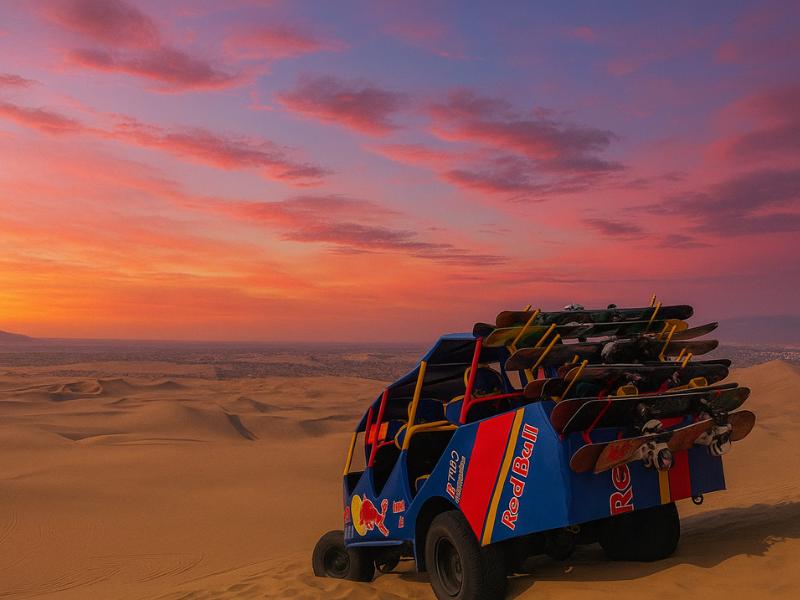
Huacachina Sunset Sandboarding & Buggy Adventure
A four-hour buggy and sandboarding session timed to end with the sunset view the legend describes.
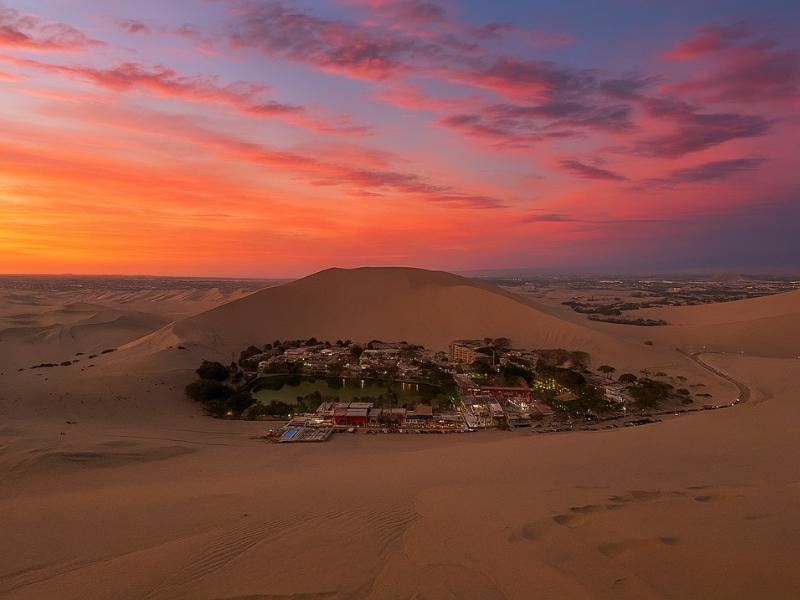
Huacachina: 2-Hour Dune Buggy Tour with Sandboarding
A shorter loop across the dunes the legend says were once a fleeing princess's cloak.
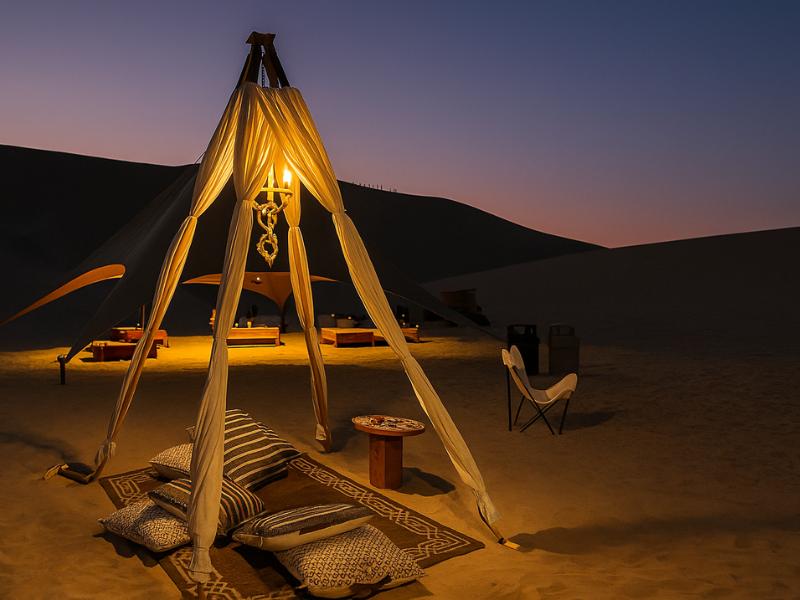
Dinner in the Huacachina Desert: Unique Dining Experience
An evening among the dunes under the same full moon the mermaid legend describes.
See the Legend's Setting for Yourself
The dune buggy and sunset tour puts you on the same dunes the legend says were once a mantle, looking over the same lagoon.